Engineering Light: Estelle Burton’s Industrial Alchemy
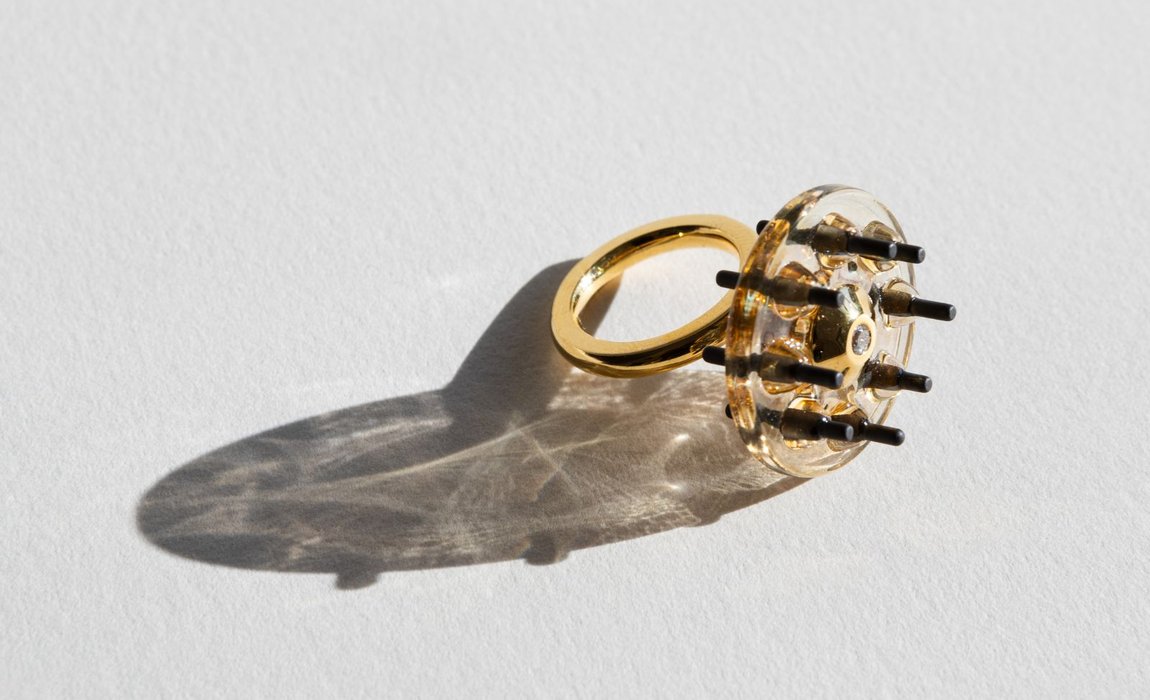
Sleeves rolled up and leaning over a decades-old lathe, jeweller Estelle Burton coaxes unlikely materials into refined forms. Using parallel lathe-based processes, Burton works with industrial metal alloys alongside discarded scientific glass, collaborating with a local glass factory to fuse the materials in the flame and restore damaged waste glass. The result brings together engineering precision with contemporary jewellery practice.
Estelle’s work moves fluidly between glass and metal, heritage machinery and emerging technologies, waste material and luxury context. At the centre of it all is a fascination with how things are made - and remade - and how materials carry histories within them.
The lathe at the heart of this process, a carefully restored Myford ML7, was acquired with support from the Goldsmiths’ Centre’s Business Catalyst (Small) Grant, funded by the Goldsmiths’ Foundation - an investment that has become central to the evolution of her studio and her work. It forms part of a longstanding relationship with the Centre, which has supported her practice at pivotal stages of development. In a conversation in 2025, Estelle reflects on this collaboration, as well as the fascinating processes, influences, and ethos behind her practice.
Innovation can come from anywhere
It’s been a long, circuitous journey. I come from a family of antique dealers specialising in scientific instruments, so I grew up around workshops, machines, and objects being repaired and repurposed – that world has always been there in the background.
Studying Contemporary Craft at University of Brighton campus in Hastings, I graduated in 2019 and was introduced to glass for the first time. A field trip to a local scientific glassworks completely amazed me – this incredible blend of hand skills, machinery, and robotics all coming together.
I became fascinated by material waste and recycling, and initially started using unrecyclable scientific glass for model-making and prototypes. I’d read that around 80% of waste is generated during the design process, so it felt like a responsible place to start - but the material soon became part of the final work, which shaped my master’s focus.
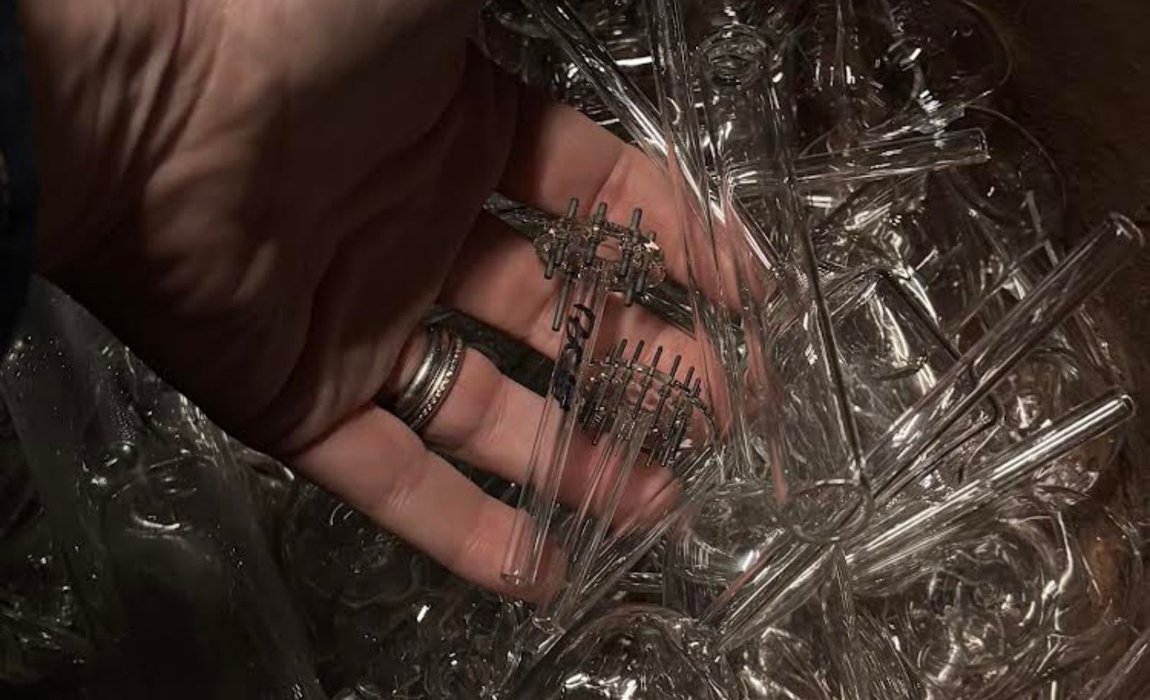
The name of my collection, Luminaire, relates to how light interacts with glass - dramatically changing colour, shadow, and projection. Many components within my work use echo valves directly, or echo valve-like forms, suggesting energy and movement, which fascinate me.
Giving Glass a Second Life
By the time I started my master’s, I knew sustainability had to be a core part of my work. Glass is often described as infinitely recyclable, but that’s not quite true.
The glass I work with is designed to bond directly with a specific metal alloy - similar to enamelling but with more structural potential. The materials expand and contract at the same rate, making them incredibly strong but very difficult to separate and recycle. Much of this material ends up in landfill.
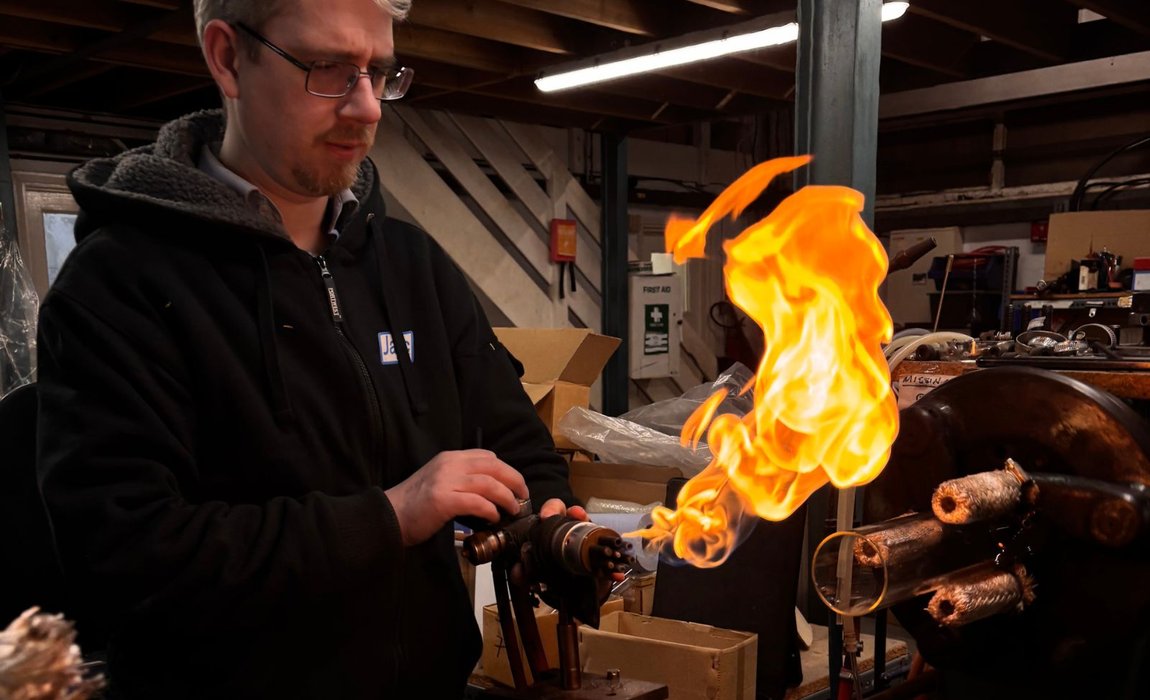
Giving it a second life in a high-craft context felt like an opportunity to draw attention to some of these challenges and open dialogue around industrial craft and sustainability. I work with local glass manufacturers to repair cracked components on the flame, making them wearable even if unsuitable for scientific use. Not everything is fully waste-based yet, but I’m testing the possibilities to ensure products are fit for purpose.
My ambition is to take this work into a more commercial space, introducing these materials to fine jewellery at a time when innovation is increasingly necessary.
Funding is about more than money
After finishing my Research Masters in Jewellery Design at Central Saint Martins, I quickly realised I’d chosen to work with some of the most expensive equipment possible – a lathe, 3D printer, and laser welder. Stepping away from that environment, I knew I needed to resource my own studio properly to be more self-sufficient.
The Goldsmiths’ Centre’s Business Catalyst (Small) Grant gave me the means to purchase a lathe – a Myford ML7 I found on Facebook Marketplace. It’s almost as old as I am – won’t say exactly how old – but it’s a beautiful machine. The grant covered the machine, transport, and local mentorship.
I was incredibly fortunate to be supported by ex-naval engineer Chris King, who rebuilt the lathe with me. He built it, I watched and learned, and together we recalibrated it, so now it’s fully operational. What began as help setting up a machine evolved into ongoing mentorship. His naval background makes him brilliant at explaining complex processes, and he’s generously shared his knowledge.
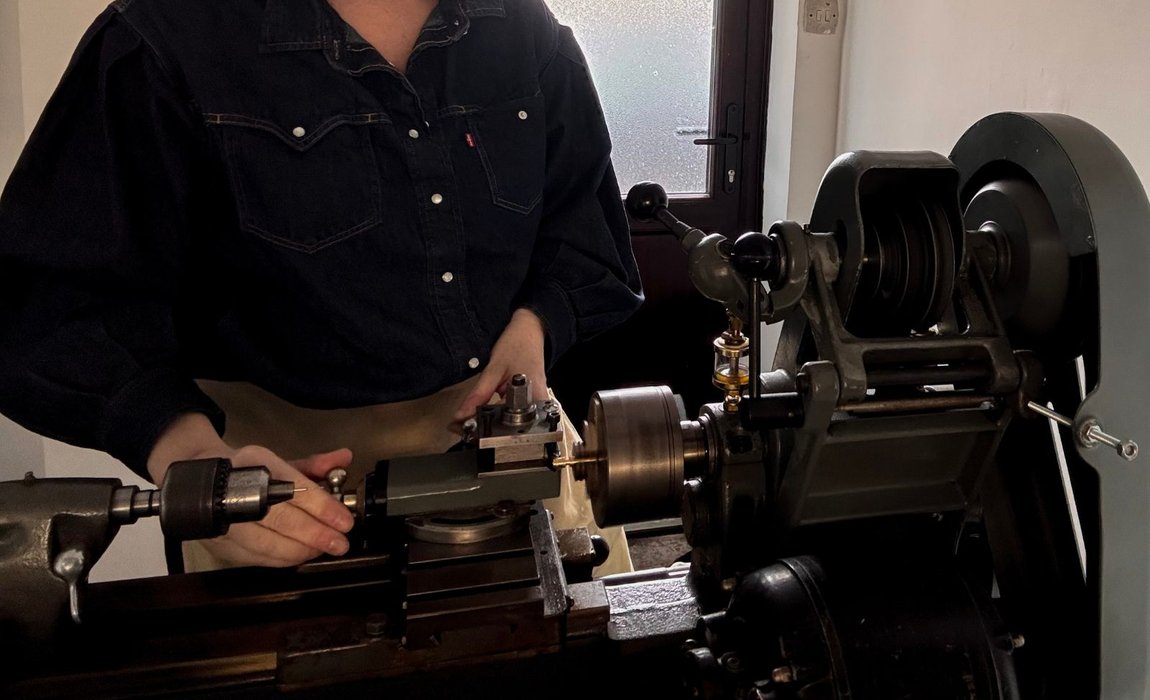
The lathe has become central to my practice, particularly because I work with glass and an unusual industrial metal alloy that’s very hard to manipulate by hand. It allows me to create fixtures, fittings and surface textures that I simply couldn’t achieve otherwise.
The lathe came from a family who cared deeply about its future. The previous owner, an elderly gentleman, had continued to use it until the end of his life, and his family later made the difficult decision to part with it. That gave me a strong sense of responsibility. What began as acquiring a machine has since fostered new relationships and deepened my respect for industrial craftsmanship - skills honed over lifetimes and rarely seen in contemporary jewellery practice.
Support is essential
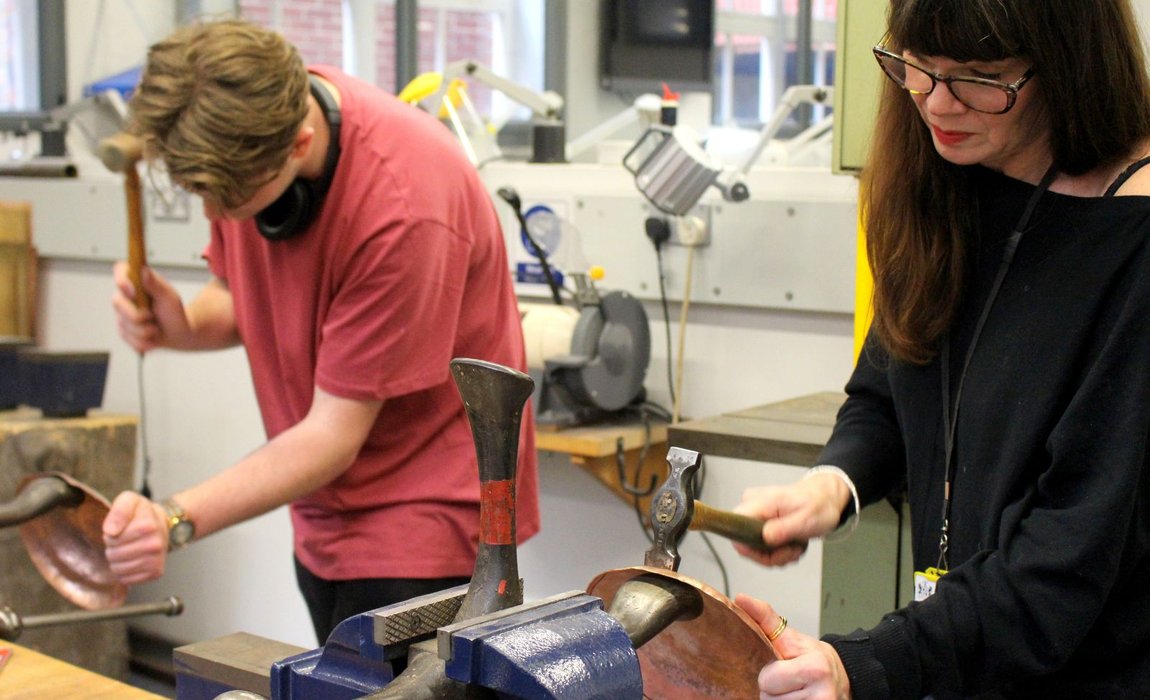
I’ve been working with the Goldsmiths’ Centre since 2019. During my final year studying Contemporary Craft in Hastings, I came across the formerly available Precious Metal Grant. That funding allowed me to create a series of hand-raised vessels for my graduate show – something I simply couldn’t have done without it.
Afterwards, I took part in skill swap sessions at the Centre, working with another silversmith who was completing an apprenticeship as well as learning the art of hand raising. He shared technical skills with me, and I shared design-based expertise with him. Our paths crossed once again during my MA at Central Saint Martins, while researching traceability of metals, and the Centre supported that research. Later, as a Bright New Gems Award recipient, I was put forward for the Getting Started Online course, which provided rounded business training – helping translate education into a viable enterprise.
The ongoing development and learning, and the fact that it isn’t prescriptive, is what makes the Centre vital to the trade. Each stage of my career has required something different – funding, business structure, technical exchange, mentorship or simply connection – and the Centre has been there at the right moments. Personally, lectures and short courses have also been hugely valuable. I’ve taken classes in chain making with Lucy Gledhill and filigree work with Filipa Oliveira. The support isn’t one-size-fits-all; it evolves alongside your practice.
I particularly value the pay-what-you-can lecture programme. With the rising cost of materials and pressures on early-stage makers, that accessibility is crucial. Funding and education act as gateways, enabling experimentation, infrastructure, and growth.
Discover More
Hear from more community members, supporters and beneficiaries and read the Goldsmiths’ Centre’s Impact Report 2024/25
Discover our Business Catalyst (Small) Grants for the jewellery, silversmithing and allied industries