What Good Looks Like and the Discipline of Making: The Goldsmiths’ Craft & Design Council Awards
Before the ceremony, before the photographs and applause, objects arrive anonymously and are placed under careful examination. Judges lean closer, studying surfaces, testing mechanisms, inspecting settings. What matters here is not the name attached to the work, nor the reputation of the workshop from which it came.
Founded in 1908 as a non-profit making organisation, the Goldsmiths’ Craft & Design Council (GC&DC) Awards were never intended merely as a celebration. Their purpose is more demanding. Each year the trade places its work before the judgement of its peers, allowing simple but rigorous questions to be asked: Is the piece well made? Does this piece demonstrate the standard the craft sets for itself? Does it push it higher?
To an outsider such attention may seem exacting, and even severe. Within the trade, however, it performs an essential function, because it creates a shared language through which craftspeople recognise quality in one another’s work, even when they come from entirely different workshops or disciplines.

In an industry increasingly shaped by visibility, speed and commercial pressure, that language matters more than ever. Jewellery today circulates quickly through images, social media and retail environments where the surface of an object often draws more attention than the labour behind it. The GC&DC Awards operate according to a different rhythm. They ask the trade to slow down and look again, not at what appears impressive at first glance, but at what lies underneath.
The process is deliberately uncompromising. Pieces are judged anonymously and considered on their own terms. Does the setting protect the stone without sacrificing light? Is the solder join resolved cleanly rather than disguised? Does the mechanism function with ease and durability? Will the object endure years of wear and repair?
These are not abstract questions. They are the practical mechanics through which the trade defines excellence.
“Much of the skill that sustains jewellery and silversmithing is designed to be invisible. A well-executed setting directs attention entirely to the gemstone it holds. A perfectly finished join leaves no visible trace of the work required to achieve it. Ease and effortlessness, when they appear in finished pieces, are almost always the result of countless hours of correction, repetition and adjustment.”
These pieces often represent well over one hundred hours of work at the bench, requiring sustained concentration, technical precision and perseverance.
The Awards bring this invisible labour into view. They allow the trade, for a moment each year, to compare its work against a shared reference point. Without such moments of comparison, even the most skilled workshops risk drifting away, their knowledge becoming private and eventually fragmented and lost.
Recognition in this context is not simply celebratory; it is vital. It tells the trade, in concrete terms, what good looks like now.
For apprentices, the pieces submitted to the GC&DC competition often represent a milestone in their training. These pieces are no longer straightforward exercises. They demand that the makers confront technical challenges which make them understand the deeper logic of the craft. This year’s apprentice entries make those standards visible in different ways.
 Alice Baker-Russel

Alice Baker-Russell’s Masterpiece – a Japanese Garden drinking set (pictured above) - reveals a growing sense of creative authorship, where narrative and object begin to inform one another. This piece, which won Alice three Gold awards for silversmithing and chasing plus a polishing award for her Ottewill’s colleague Callum Hutchins, required Alice to not just design, make and project manage the piece, but also to develop her leadership skills to ensure the piece met her creative intentions and Ottewill’s commercial ambitions.
 Joshua Hook
Joshua Hook’s Infinite Geometry necklace tackles engineering challenges that demand careful spatial understanding. The piece comprises of 30 links – all handmade, a box catch and two pendants, one of which is detachable and Josh’s style leaves no room to hide with accuracy and symmetry required from every section. Josh won a Gold Award in 3D Craft for diamond mounting and the Theo Fennell Apprentice and Master Award for his Masterpiece which was created in the final year of his apprenticeship with Dominic Walmsley.
 Krishnan Vara
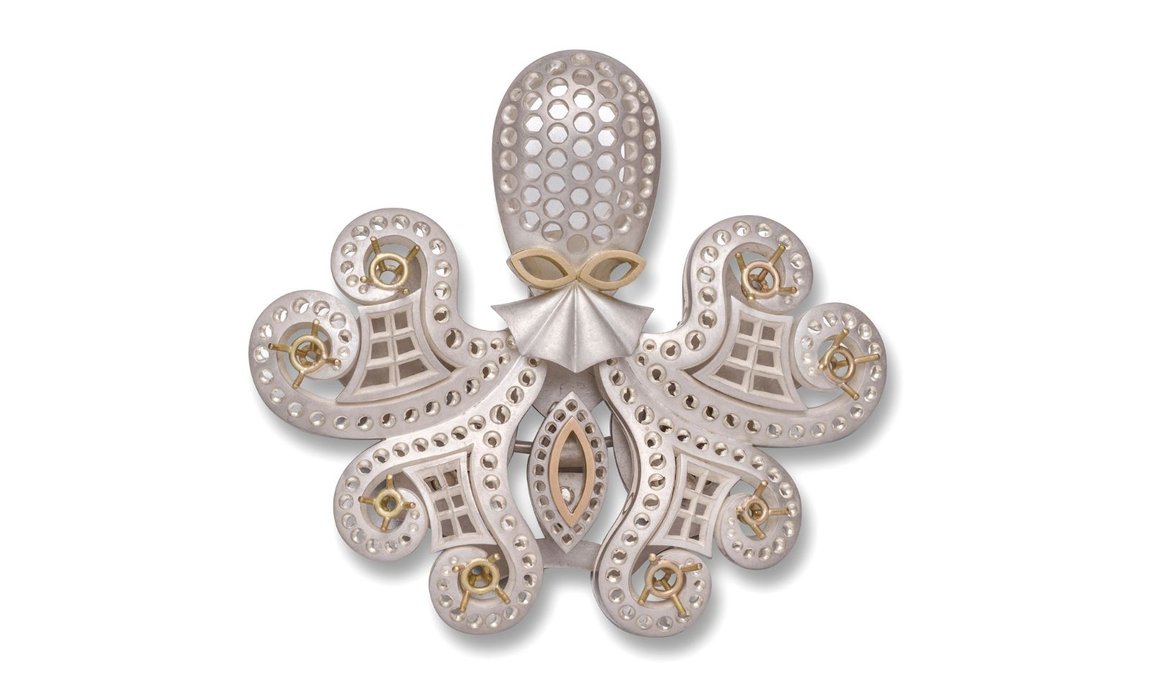
Former Foundation Programme student and current third year apprentice with Bobby White, Krishnan Vara’s en-tremble brooch also received a Gold in 3D Craft for diamond mounting. Described by judges as exquisite, the piece reflects a level of control and refinement that is rare for a such young maker. This level of achievement does not emerge in isolation. Behind each piece sits a network of training, mentorship and shared knowledge.
 Esther Illett
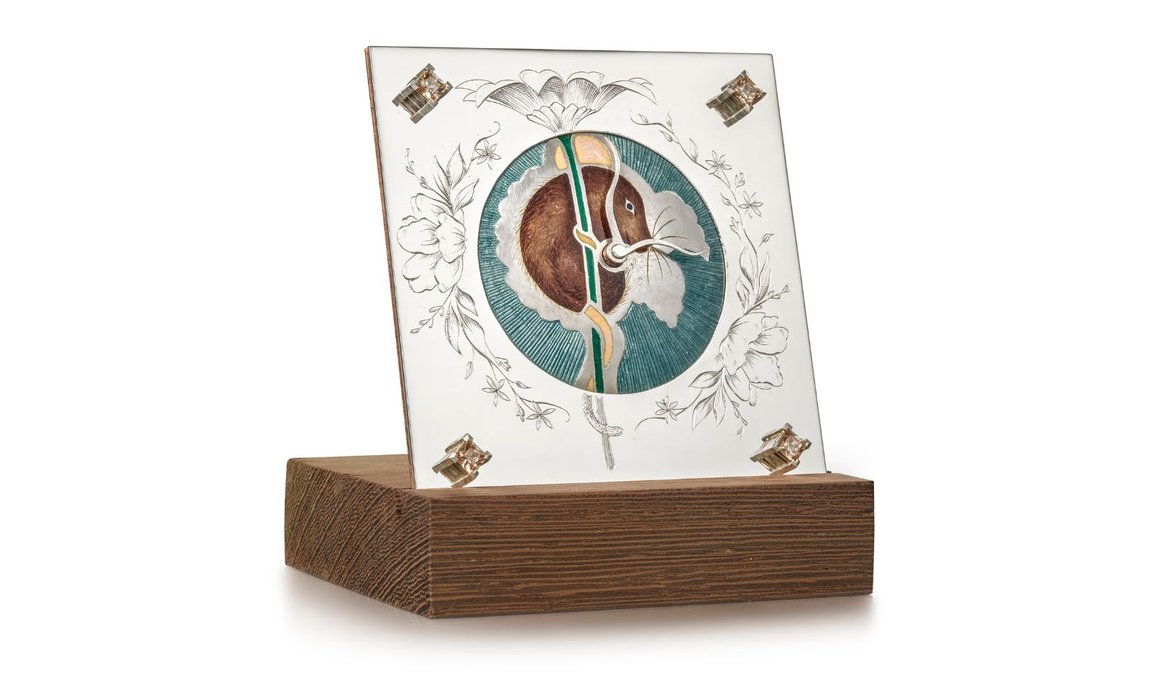
Esther Ilett, apprentice mounter at Cartier, was awarded Gold for enamelling and Bronze for engraving for a piece made during the Goldsmiths’ Centre’s Day Release programme showing how through off the job training alongside workshop practice, apprentices develop not only technical skill but the breadth required to work across disciplines. All the winning objects stand as both a culmination of that process and a clear indication of the standards the next generation of craftspeople are capable of achieving, and the qualities the trade wishes to see carried forward.
This progression reflects how technical training can continue to underpin excellence as apprentices move into professional practice.
The argument for maintaining technical standards is sometimes framed in terms of heritage, as though the craft was simply preserving the past. In reality, the opposite is true.
“When a technique disappears, the loss is not confined to history, because it reduces the range of problems a maker can solve in the future. It narrows material understanding, weakens the possibilities of repair and conservation, and ultimately limits the creative vocabulary of the trade itself. Continuity, in this sense, is not about resisting change, but rather about maintaining enough knowledge and judgement for the craft to evolve with confidence.”
Each year the Awards perform the same essential task. They ask the industry to pause and look closely at what it produces, and to decide what standards it is willing to uphold.
The ceremony itself is brief. What remains unchanged, however, is the culture of judgement behind it. The understanding that excellence in jewellery and silversmithing is neither accidental nor self-declared, but recognised slowly, through the careful evaluation of peers who understand what it takes to make something well.
In a sector increasingly shaped by speed and visibility, that culture of careful judgement may appear old-fashioned. In truth, it is what allows the craft to move forward without losing its foundations.
And it is why, more than a century after their founding, the Goldsmiths’ Craft & Design Council Awards remain one of the trade’s most valuable points of reference: a place where the industry can still ask, with clarity and honesty, what good truly looks like.
To enter the GC&DC Awards, visit www.craftanddesigncouncil.org.uk