Isabelle Capitain: Championing Craft Through Work Experience Placements
German-born jeweller Isabelle Capitain brings a quiet precision to her craft - a clarity of form and function shaped by the Bauhaus principles she so admires. In her East Dulwich atelier, beneath the hum of tools and the soft gleam of gold, she translates minimalist lines and geometric purity into jewellery that balances traditional craftsmanship with modern precision. A firm believer that skill is a language best passed from hand to hand, Isabelle supports the Goldsmiths’ Centre’s mission to equip young people with the craft of jewellery and silversmithing. Through work experience placements in her studio and showroom, she offers aspiring makers not just technical insight, but a glimpse into the rhythm and reality of life at the bench. We spoke with Isabelle about her journey from Germany to London and why she believes offering these formative opportunities is essential to the future of the trade.
Early Influences and Beginnings in Jewellery
How did I discover jewellery? Well, in Germany you’ll find workshops and jewellers in almost every town, no matter how small. My mum loved jewellery - she was a milliner - so creativity and working with your hands were always part of our family life. Going to the jeweller for her birthday or special occasions was just something we did; it wasn’t discussed, it was obvious.
After completing my A-Levels, I went to university but didn’t really enjoy it, and started looking for something completely different. That’s how it all began. I quit uni, phoned around trying to find an apprenticeship somewhere near where my parents lived, did a week’s trial, and got offered the placement. That was three and a half years of being an apprentice.
Apprenticeship and Early Career
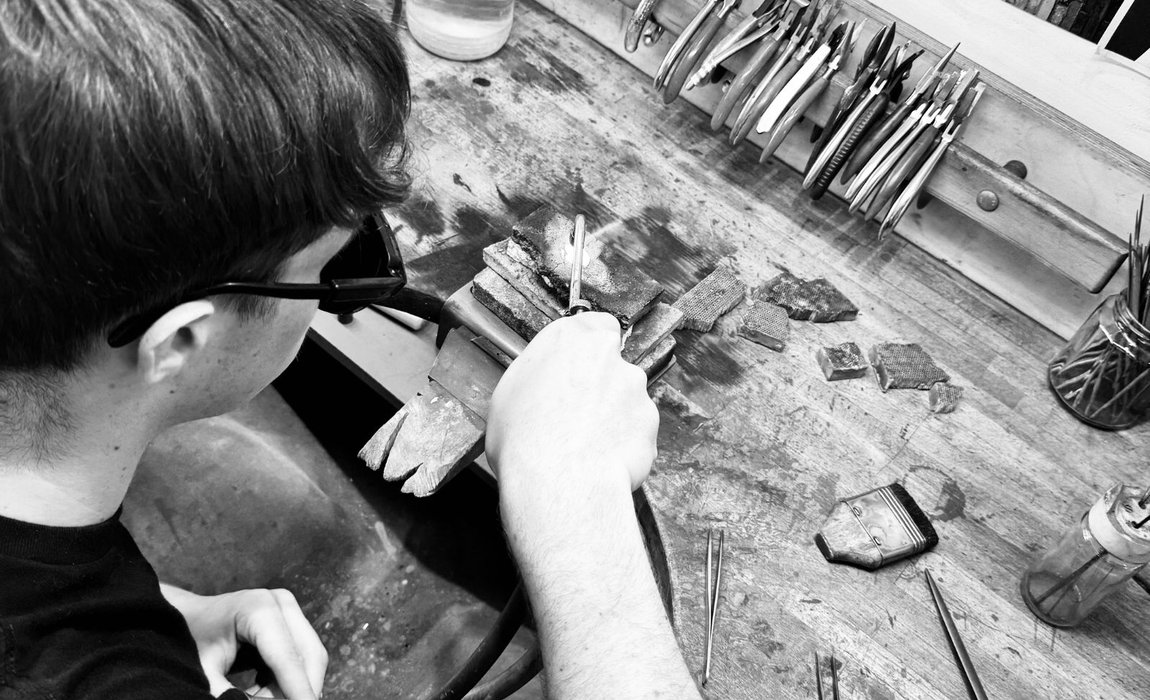
In Germany, the system works so that you spend four days a week at the bench in the shop that’s taken you on, and one day a week at college, where you study technology, metallurgy, chemistry, maths, drawing, economics - all the things you need both to run a small business and to be a decent goldsmith. So there’s a lot of theory-based training as well as hands-on bench work.
After finishing my apprenticeship in 2008, I started thinking about my options. At the time, there weren’t really any jobs going in that part of Germany, so my choices were either to go abroad or move to southern Germany, where most of the jewellery industry is based. By sheer luck, I found a job in Canterbury, Kent, working for another German goldsmith. I thought I’d go over for a year, learn some new bench skills, and then move back. But I’ve been here ever since, so that worked out rather well.
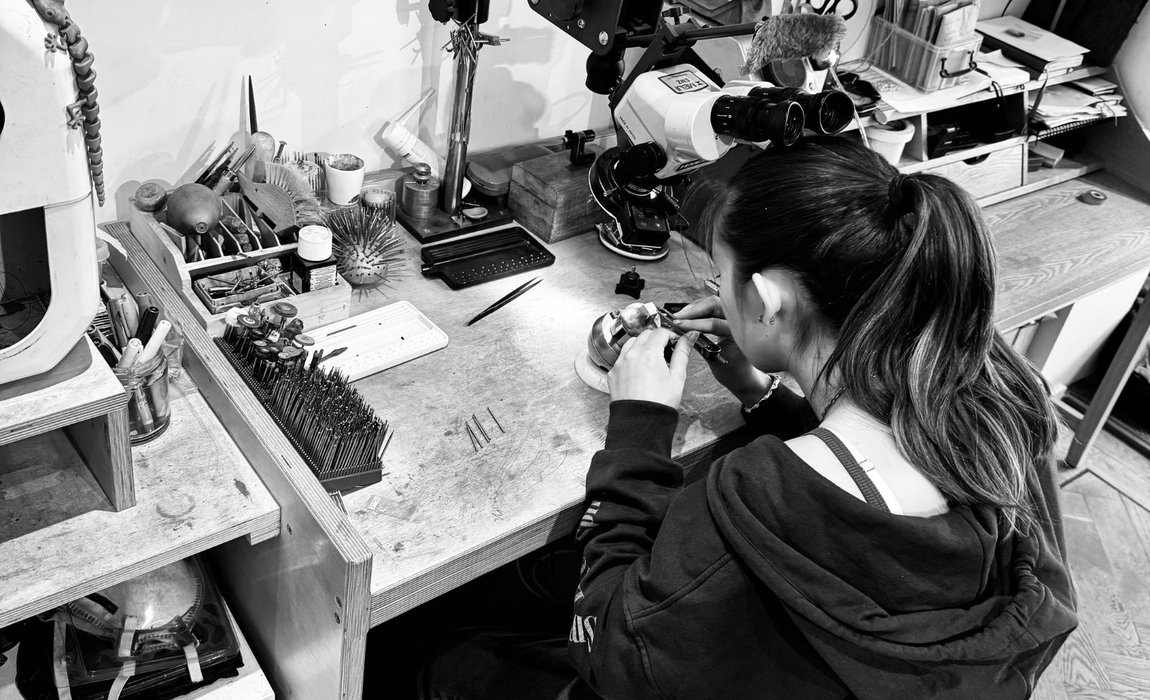
I worked in Canterbury for almost four years, then moved to London, did some freelance work, and later took a permanent position with a jeweller in North London. There I did bench work, stone setting, workshop management, and training of juniors - all of that. So I’ve seen quite a few different workshops before deciding to go self-employed, which I think is quite helpful; at least you learn what you don’t want to do.
When I was at university, I found it far too theoretical - quite boring, really. It was a literature degree, and while that’s great, you don’t really see progress or feel like you’re doing anything. Jewellery, on the other hand, is so tangible. You start the day with a bar of metal and end it, hopefully, with a finished ring or something beautiful. It’s physical, engaging, and creative. I’ve always liked tinkering with things and keeping my hands busy - seeing something you’ve made by the end of the day is very satisfying.
Introducing Work Experience Placements
As for offering work experience placements - I blame that entirely on Stuart Jenkins. He’s one of the teachers on the Foundation Course and a good friend. He said to me, “I’m teaching this course and there’s a lad you’d really like - great attitude, you’d want him in your workshop. Come to the end-of-year show.” I knew about the course but had never been to the show before. When I went, I was stunned by the quality of work produced in just nine months. So, that summer, one of the students was at a loose end, and I said, “Come for a week, see how it goes.” That was about three years ago now, and it went really well - he’s now working for friends of mine.
I’ve only ever had students for a week each, which makes it hard to get to know them properly, but it still works - we fit a lot into that week.
Becoming a Mentor and Teacher
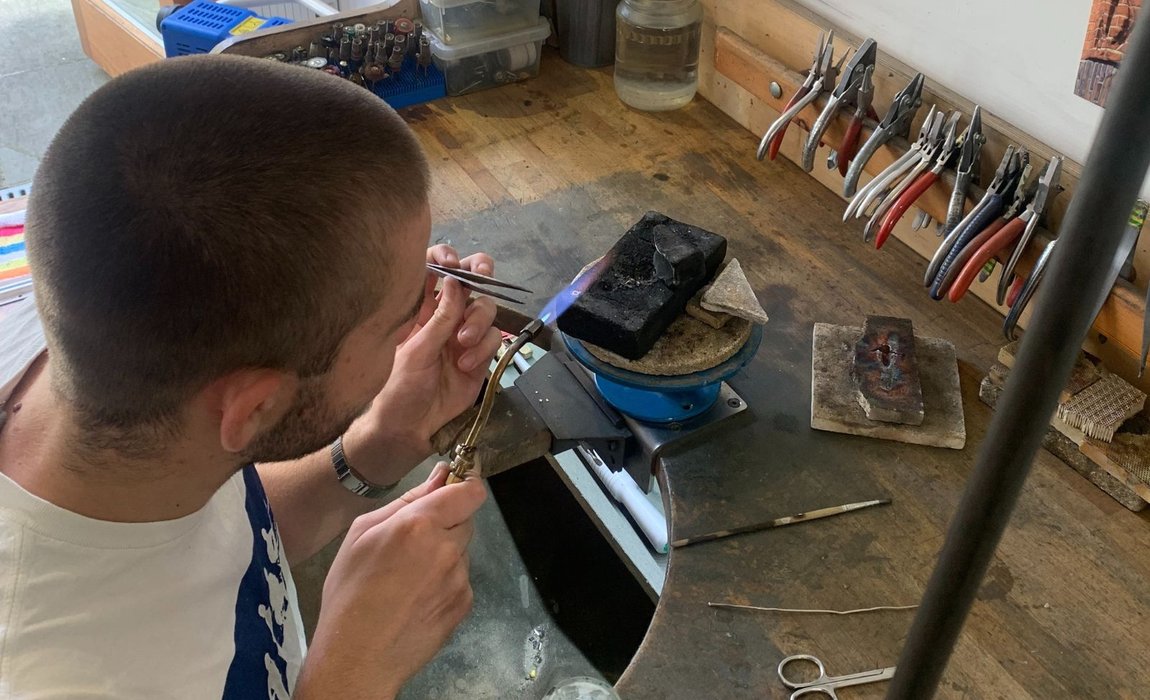
Teaching is definitely a steep learning curve. You don’t realise how many things you do instinctively until you have to explain them to someone else. Suddenly, you find yourself saying, “Oh, right, I need to mention that - that bit’s actually crucial.” You have to break down things that come naturally into tiny steps. It’s fun, though, especially when you see someone grow in confidence, even over just a week.
When structuring a work experience week, I always start by asking if there’s something in particular they’d like to focus on. The first student I had didn’t mind, so I started slowly - melting gold, drawing wire, just to get used to the tools and environment. The second student had a project of his own, which I encouraged. If someone brings their own work, they’re usually more invested. I’ll always have a few standard exercises in mind, but I prefer giving them real jobs - actual pieces - because it’s more meaningful, and confidence grows faster.
The Impact of Work Experience
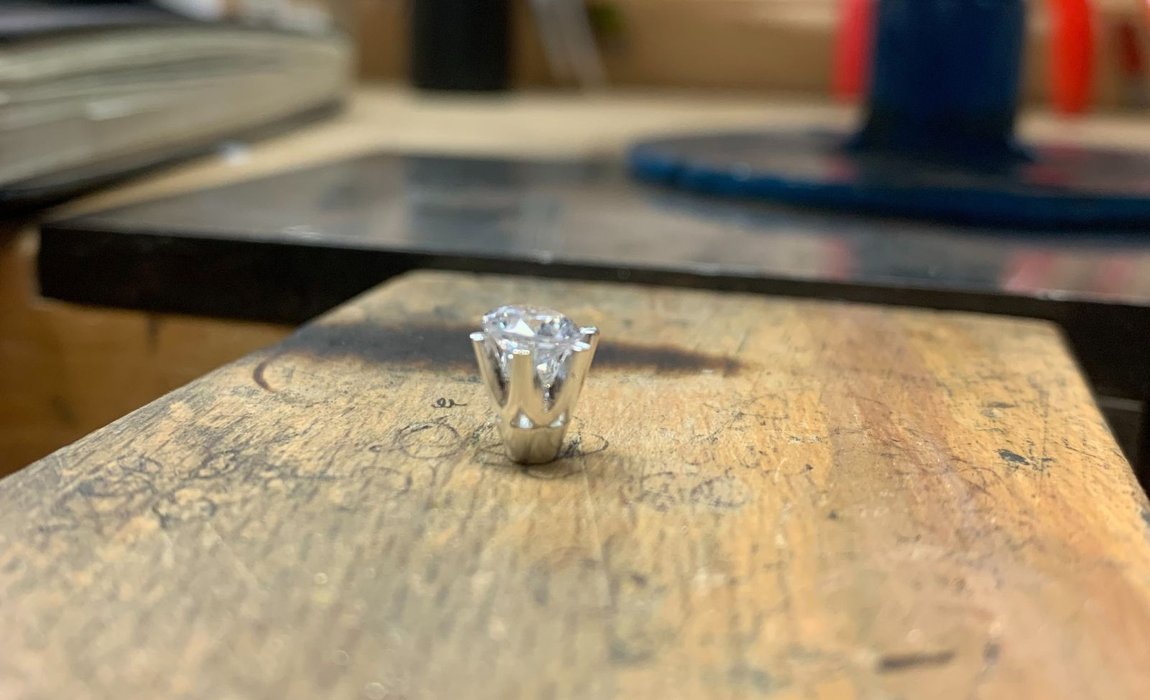
One memorable trainee was a girl called Evie who joined this summer. She was quite nervous at first - not very confident - but incredibly focused. She was only 17 at the time, turned 18 just after the placement. I’d show her something, and she’d remember every step. By the end of the week, she’d completely transformed - much more confident and engaged. She built a perfect hollow cube with a set stone, using the laser welder, which terrified her at first but came naturally by the end. The result was fantastic - so neat and professional. She’s now an enameller apprentice and absolutely loving it, which is great to see.
Another part of work experience, I think, is sharing resources - where to buy bullion, which stone dealers to use, how to calculate prices. One of my trainees had a project and wanted to know how to charge for it, so we talked through that too. I believe in sharing knowledge. That old-school idea of keeping trade secrets to yourself is nonsense. The more we share, the stronger the industry becomes.
Guidance for Other Employers
For other businesses thinking of offering placements, I’d say: assume you won’t get much of your own work done that week. Be there for the student, take time to explain things, and don’t just leave them in a corner. Show them what you’re working on, so they can see where those small exercises can lead. Ask what they want to focus on, listen, and pay them something - even just enough to cover travel or lunch. It’s important to recognise their effort.
It is a sacrifice, but an important one. We can’t complain there aren’t enough young people coming into the trade while also refusing to give them opportunities.
Lessons from the Bench
From my own training, I’ve learned patience is absolutely essential. You can’t do this job without it, because there’ll be moments when you just want to throw everything out of the window. You also need to take constructive criticism well - if someone says, “It’s not good enough,” it doesn’t mean you’re not good enough, it just means the piece isn’t quite there yet. Those two things are crucial.
Curiosity is also key. Don’t be afraid to ask questions, even if they seem silly. Take notes, pay attention, be thorough. A good taste in music helps too - though that’s probably not essential!
Mistakes are part of the process. I made plenty during my training. Sometimes I had to make a piece three or four times before it was good enough. It’s tedious, but repetition helps you improve.
For anyone considering a career in jewellery, I’d say: figure out whether you want to go down the design route or be at the bench. You can always do both, but it’s good to know which direction interests you most. And if you’re considering the trade route, the Goldsmiths’ Centre is the best place to start. It opens doors, gives you a taste of what the industry is like, and introduces you to different specialisms - stone setting, enamelling, engraving, silversmithing. Most importantly, it helps you decide what suits you.
It’s not an easy job and it won’t make you rich, but it’s incredibly rewarding - and that’s worth a lot.
If you’re a jewellery or silversmithing business inspired by this article and able to offer work experience to our Foundation Programme students, please contact Lili Capelle, Vocational Curriculum Manager, for further details and to explore the next steps.