Creativity, Craftsmanship, Community and the 4th C of Peter Taylor
There is a particular quiet to Clerkenwell in the early months of the year. On Britton Street, the Goldsmiths’ Centre appears steady in that stillness, a building that does not call attention to itself, yet is unmistakably there.
Peter Taylor has occupied this corner of the city from before the Centre existed, having visited the site in 2003 when it was part of Central St Martins property portfolio. He will leave it this spring. When he speaks about his retirement, there is little of the ceremonial about it. Instead, he talks as if he is stepping out of a current that will keep moving without him.
If there is a mood that threads through his reflections, it is neither nostalgia nor triumph. It is closer to watchfulness: a sense that institutions, like people, are shaped by countless small inflections over time, and that the most consequential moments are often the least dramatic.
Peter does not begin with a story about founding. He begins with a description of a problem.
In 2002, when he joined the Goldsmiths’ Company, the trade he encountered was already under strain. Affordable workspace in London was thinning out, support for graduates was uneven and largely dependent on chance, and training pathways were shifting as polytechnics became universities, leaving fewer routes that combined intellectual rigour with sustained time at the bench.
He uses the phrase “market failure” to describe this, but he does not sound like an economist. The term functions less as a technical diagnosis than as a moral one: a recognition that the conditions necessary for a craft to reproduce itself were eroding, not because of a single decision, but because of the slow accumulation of pressures that no one institution was designed to absorb.
“What is striking about Peter’s account is how little he centres himself within this story. He does not present the Goldsmiths’ Centre as a personal vision finally realised, but rather a necessary response and a structure that had to be built because the landscape had become inhospitable to certain kinds of work.”
This instinct to see himself as one actor among many is consistent throughout his career. When he reaches back further, to 1994, he recalls drafting a proposal in Birmingham for what he called a “jewellery resource centre”: a place that would bring together training, workshops, graduate development, and a gallery. He simply notes, with a faint hint of disbelief, how closely that early sketch resembles what the Goldsmiths’ Centre would eventually become.

The more pivotal figure in his story is Stuart Devlin, a creative, designer, and one of the most respected figures in British jewellery and silversmithing industry, is, in Peter’s telling, not merely a supporter but the originator of the Centre. His reputation carried weight in a trade that has little patience for empty promises. His endorsement signalled that this was not a vanity project or a charitable add-on, but something the industry itself required. Of course others played an important role too overseeing and championing the project, building the business case and exploring the opportunities offered by the site. However, and Peter is unusually direct on this point: without Stuart, the Centre would not exist at all.
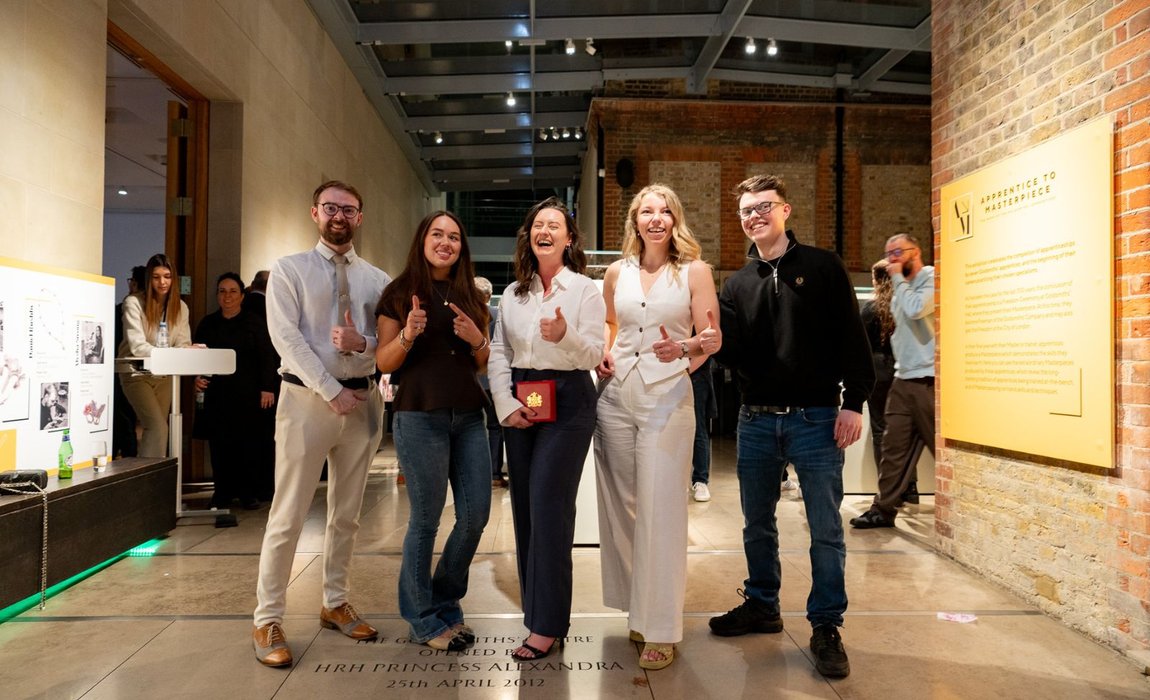
The most affecting detail in the interview arrives quietly, almost in passing. On the day the first cohort was interviewed for the Postgraduate Professional Design Programme, Stuart Devlin suffered his first stroke. Peter’s regret is not that the Centre stumbled or faltered in its early years but that it ‘took too long’ and Stuart did not live to see the institution he had helped make possible in full operation.
If he could alter one thing, he says: ‘It would be to give Stuart Devlin five years inside the Centre delivering his Postgraduate Professional Design Programme.’
It is a revealing wish. It suggests that for Peter, the value of an institution is measured less by what it produces than by who gets to inhabit it. Buildings matter; people matter more.
He returns, again and again, to apprentices. Not as a statistic, but as people in the process of becoming professionals. In the past, he says, many apprentices were isolated within their workplaces, often the only young person in a room of seasoned specialists. They learned their craft, but they did so largely alone.
One of the subtle transformations he identifies is that apprentices now know one another. They form networks that extend beyond their training years, shaping how they work, who they collaborate with, and how they treat the next generation. For Peter, this is central to the Centre’s purpose.
“His reasoning is simple but far from simplistic: if you train someone properly and treat them properly, they are more likely to train and treat others properly in turn. Skills, in this view, are inseparable from ethics. The way a trade behaves becomes part of what it passes on.”
This belief in the social dimension of craft underpins much of his thinking about the industry itself. He describes the UK jewellery and precious metals sector as ‘symbiotic’”, a network of interdependent specialists – mounters, setters, casters, silversmiths, spinners, engravers - whose survival depends on proximity, trust, and mutual reliance.
The Goldsmiths’ Centre, in his account, functions as a kind of compressed version of that ecosystem: a place where different kinds of expertise coexist, where small businesses can operate within a shared infrastructure, and where the fragility of individual practices is buffered by collective presence.
‘This is not’, he insists, ‘about nostalgia for a vanished artisanal past. It is about preserving the conditions in which high-level craft can continue to exist in a city that has grown increasingly hostile to small-scale production. ’
‘London’, he notes, ‘is not the only centre of the trade, but it remains a crucial one. And the Centre’s significance lies partly in making that centre more permeable. ’
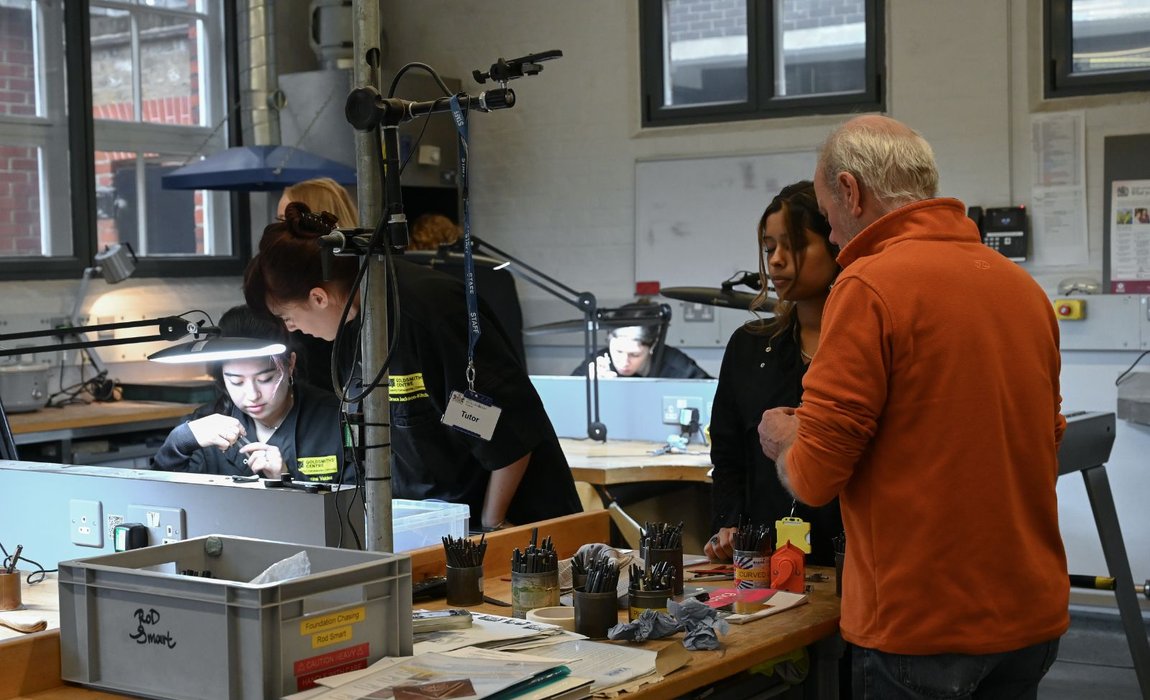
Peter’s own life trajectory underpins this point. At seventeen, growing up in Birmingham, he wanted to become a Goldsmiths’ Company apprentice only to learn that he could not, because the opportunity was geographically constrained. Today, however, he could. It is just one of the measures of how access has shifted since the Centre was established.
The Centre, in his description, has a ‘front door’ that can be walked through both physically and metaphorically. It implies visibility, openness, and a rejection of the idea that the trade should be closed off to those outside its immediate orbit.
If there is a single story that crystallises his philosophy of legacy, it is the one he tells about Agas Hardyng.
‘Hardyng, centuries ago, made a gift that contributed to the Goldsmiths’ Company’s charitable foundations. She could not have known’, he says, ‘that her act would eventually play a part in the creation of the Goldsmiths’ Centre more than five hundred years later. Yet it did. ’ This is not a sentimental anecdote for Peter, but a working, living principle: privilege brings responsibility, and the effects of generosity often extend far beyond what the giver can imagine. The question is not whether you can foresee the outcome, but whether you are willing to act without certainty.

It is in this light that he views his own role. Not as a founder carving his name into history, but as someone who happened to occupy a position from which certain things could be made possible. He does not inflate that position, but he does not disown it either. He speaks with the calm confidence of someone who understands both the limits and the potential of institutional power.
As he prepares to step aside, Peter Taylor is acutely aware that this is not an ending but a handover.
The appointment of Julia Balchin as Interim Director marks the first time the Centre will be led by someone offering a new interpretation of the original ambitions that Peter Taylor and Stuart Devlin helped to shape. He is careful here, however. He knows that parts of the trade may be wary that Julia Balchin does not come from a jewellery background. Yet he frames her differences as necessary rather than risky.
‘The Centre’, he suggests, ‘has reached a stage where stability is no longer the only priority. The world in which it operates, culturally, economically, technologically, has changed and new skills, perspectives, and forms of leadership are required to navigate that landscape. ’
This is where his ‘hunters and farmers’ metaphor comes in handy. The farming has been done: the soil prepared, the structures embedded, the institution made dependable. Now comes the hunting: scanning for opportunities, forming new alliances, ensuring that the Centre remains relevant not through reinvention for its own sake, but through attentive adaptation in the changing times.
Peter does not present this as a critique of his own tenure. If anything, it reads as a recognition of its success.
What lingers most, listening to him, is not a catalogue of achievements but a particular way of thinking about what leadership entails.
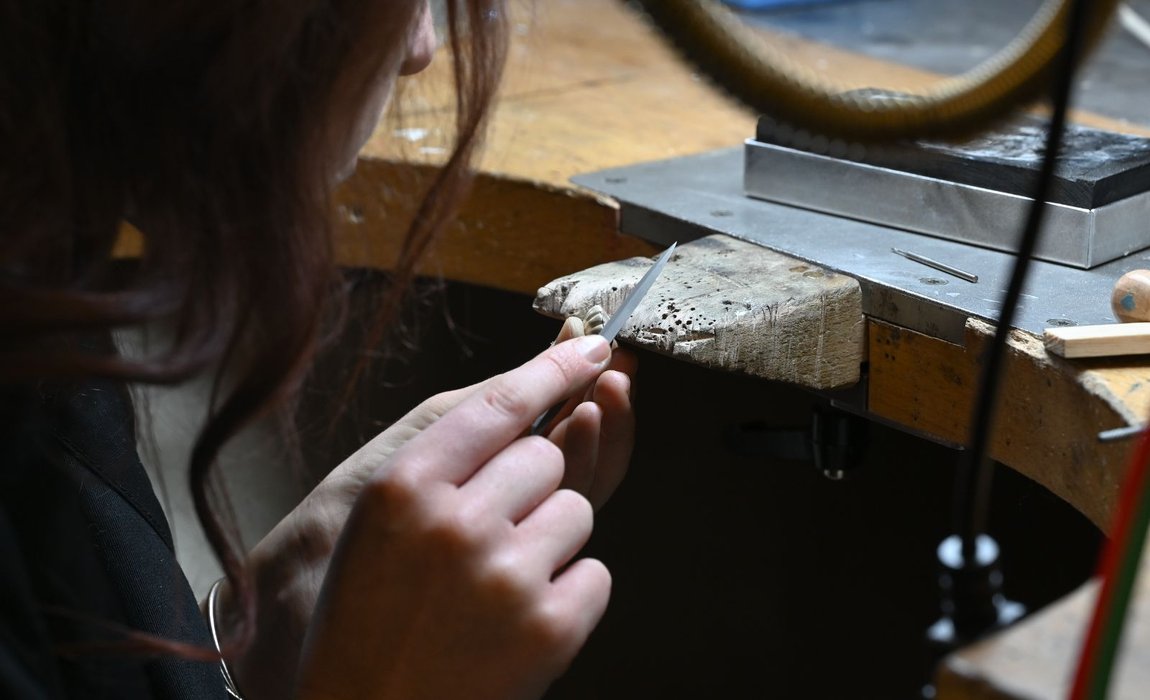
He is less interested in monuments and more concerned with what gets handed on: the habits of training, the ethics of care, the networks of trust, and the infrastructure that allows others to work, fail, recover, and try again.
In that sense, his legacy is as much behavioural as it is material. It resides in the apprentices who now recognise one another, in the small businesses that can continue to operate in central London, in the regional barriers that have begun to disappear, and in the idea - perhaps most important of all - that a Livery Company can use its resources in ways that meaningfully serve a contemporary trade.
Peter does not seek to define the Centre’s future. He simply makes space for it.
As he leaves Clerkenwell, the building will remain, the workshops will continue, the apprentices will progress, and a new director will begin to shape her own version of what the Centre might become. What he has ensured is that she will inherit not just a functioning institution, but a set of values sturdy enough to guide her.
In a trade accustomed to thinking in decades and tolerances measured in fractions of a millimetre, that kind of inheritance is anything but small.