Thinking About Offering Work Experience?
If you’ve ever thought about hosting a student but aren’t quite sure what it would involve, this guide answers the questions we hear most often from workshops.
- Do I need to pay them?
- What would they actually do while they’re with us?
- How much time does it take?
- Am I covered for insurance?
- Is it worth it for my business?
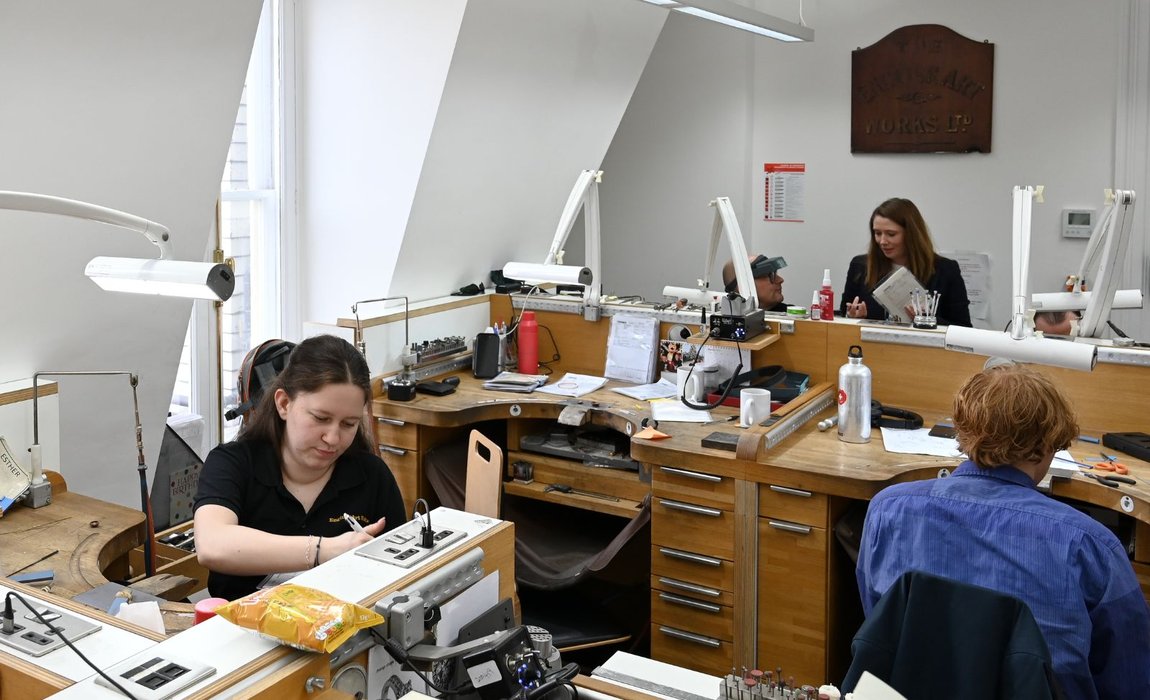
In 2026, 25 workshops across London and the South East opened their doors to our students, from fine jewellery and setting to CAD, silversmithing, production work, engraving, enamelling and medal making. Every placement looked different. All of them make a difference.
FAQs:
For short placements with students aged 18 and over, there is no requirement to pay them.
They remain enrolled on our programme and the placement forms part of their training. Some employers choose to help with travel or lunch costs, but that’s entirely optional.
If you’d like to talk it through, we’re always happy to have a conversation.
Students are not expecting to be given responsibility for production work. What they gain most is insight into how a real workshop runs. The rhythm of a working bench teaches things no classroom can fully replicate. In practice, this might include:
• Shadowing bench work
• Observing repairs or stone setting
• Supervised bench exercises
• Assisting with preparation or finishing processes
• Observing CAD workflow
• Running occasional workshop errands or supplier collections
• Sitting in on client or supplier conversations
Where appropriate, students may undertake small practical tasks under supervision. The level of involvement always reflects your workflow and comfort.
Our students arrive having completed an intensive, skills-led training programme, the Jewellery Foundation Programme. By the time they begin their first placement, they will have undertaken around seven months of focused, practical bench training, with commercial awareness embedded from the outset. They are confident with core technical processes, understand workshop discipline and are familiar with professional expectations. Placements allow them to apply and strengthen those skills in a real working environment.
In many cases, placements have led to apprenticeships or employment because both workshop and student recognised a strong fit in skills, attitude and working style.
“The level and standard of the students we hosted demonstrated the high quality of foundational training from the Goldsmiths’ Centre and real motivation.” Placement host
Very little beyond what you already do every day. You don’t need to design lessons, commit long-term, or create special projects for the students. A short induction and some guidance are often enough. We remain the main point of contact throughout. If anything feels unclear, we step in.
Many in the trade tell us they get more out of it than they expected.
A potential talent pipeline
Work experience gives you early access to motivated young makers before they enter the wider job market. It allows you to spot potential and assess attitude and technical ability early. For some workshops, placements have led directly to apprenticeships or future hires.
Passing on knowledge within the trade
Mentoring a student gives your team the opportunity to share practical experience and reflect on how skills are passed down. In a craft built on bench learning, that exchange matters.
Standing within the trade
Supporting emerging talent signals commitment to craftsmanship and continuity. In a close-knit industry, reputation and relationships carry weight.
In an industry like ours, knowledge is transferred person to person. Opening your workshop, even briefly, helps keep that chain unbroken.
“I so enjoy having students and being able to show them the real side of the trade. It’s important for the future generation.” Placement host
For students aged 18 and over, DBS checks are not required.
If you already have Public and Employers’ Liability Insurance, you are typically covered. We can review this with you if needed.
Students receive health and safety training before their placement. A short introduction to your own workshop procedures is sufficient.
Conversations with workshops help shape how we teach technical standards, professional behaviour and commercial awareness. When bench and classroom stay connected, students arrive more aware, more confident and better prepared to contribute. Work experience is one of the simplest ways to keep that connection strong.
Interested in offering a placement?
If you’d like to explore it, start with a conversation. Call + 44 (0)20 7566 7650 or email professional.training@goldsmiths-centre.org
Tell us a little about your workshop and what you do. We’ll help shape something that works for you and match a student aligned with your area of the trade.